Imagine what would happen if every home, school, playground, senior center, and park in the world took just one day each year to evaluate and improve its pollinator habitat. Together, we could create hundreds of thousands of new patches of bee-friendly space — a connected, living network running through every neighborhood on earth. The bees are waiting. All we have to do is build it.
It starts right where you are, with three steps.
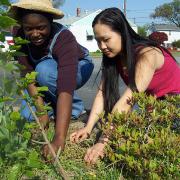
Photo: Crystal Raner |
Step 1 — EvaluateHow bee-friendly is your space, really? Most gardens have more potential than their owners realize — and a few easy-to-fix problems they don't know about. Take our free Habitat Assessment → Answer a short set of questions about your site — what's planted, what's bare, whether there's water, what pesticides are used — and get a score with specific, actionable suggestions for improvement. It takes about 10 minutes. What you learn might surprise you. The assessment works for any outdoor space: a backyard, a school garden bed, a strip of lawn next to a senior center, a corner of a city park. You don't need acreage. You need curiosity. |
Step 2 — ActPick one thing from your assessment results and do it. You don't have to overhaul the entire garden in an afternoon. The research is clear that even small improvements — a patch of native plants, a bare spot of soil for ground-nesting bees, removing a single pesticide from your routine — can meaningfully change which bees can survive at your site. Some of the most effective actions are also the simplest:
Not sure where to start? Our bee garden guide walks through what to plant and how to structure your space for maximum bee diversity. |
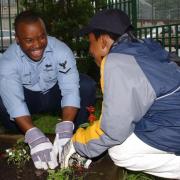
US Navy / public domain |
Step 3 — Share
This is where the challenge multiplies. One person improving one garden is wonderful. One person bringing three friends, two schools, a senior center, and a local park into the work is a movement. Share what you did, what you found, and what changed — and invite others in.
Here are some ways to make the sharing stick:
- With kids and schools
- Take a class or family for a walk through your improved garden. Have the kids interview you — what did you change, and why? What bees have shown up?
- Challenge students to photograph or draw as many pollinators as they can find, then identify them using our Pollinator Gallery or Discover Life's identification keys. Can they learn 5 new species?
- Invite a local bee expert, master gardener, or naturalist to lead a garden walk. Many are eager to share what they know.
- In your community
- Find a nearby school garden, senior center, or public park and offer to do a habitat assessment with them. Help them build a plan for next year's improvements.
- Recruit a local artist to create a mural, mosaic, or short film celebrating pollinators and the people who tend their habitats. Children's drawings of bees make a surprisingly compelling library exhibition.
- Hold an outdoor event in the garden — a concert, a picnic, a community planting day — and make pollinators part of the story.
- Online
- Post your before-and-after photos. Share your habitat assessment score and what you did to improve it. Tag us — the more people who see that this is possible in an ordinary yard or schoolyard, the more people who will try it.
- Submit a pollinator count from your newly improved space. Watching your numbers change over seasons as the habitat matures is one of the most satisfying parts of this work.
Ready to find out how your space scores?
The habitat assessment takes 10 minutes and gives you a concrete plan.